The forest footprint of AI: Google’s Finnish clearances demand answers
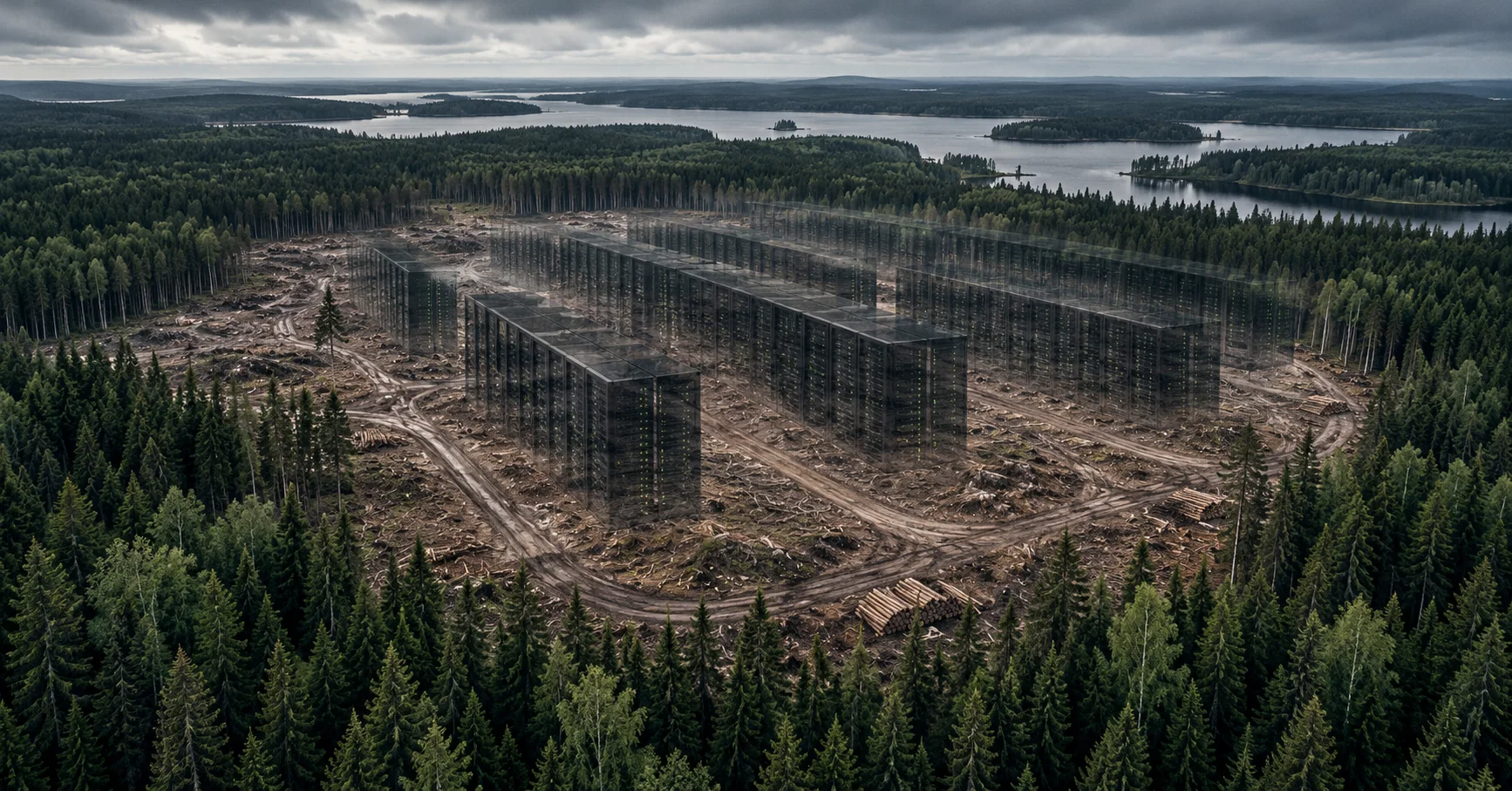
Hundreds of hectares of forest have been cleared at Google’s planned data centre sites in Finland. The controversy raises a question that deserves far more attention: what should the natural world be expected to surrender for digital growth?
We talk about the cloud as though it floats above us. In Finland, its footprint is firmly on the ground.
Google’s planned data centres in Muhos and Kajaani have become the focus of a dispute over forest clearance, environmental scrutiny and the speed of technological expansion. Finnish broadcaster Yle reports that 330 hectares of forest were cleared in Muhos and just under 200 hectares in Kajaani. Google’s Finland country manager has apologised, while maintaining that the company believed it was acting within the law.
The Guardian puts the estimated loss at Muhos alone at 250,000 trees.
For Felled.org, this is a story about how tree loss becomes possible—and whether the systems intended to prevent unnecessary destruction intervene early enough to matter.
The assessment should come before the damage
Finland’s Licensing and Supervision Authority, known as LVV, instructed Google’s subsidiary Tuike Finland to halt preparatory work at the two sites until environmental impact assessment procedures were completed.
According to Yle’s account of the authority’s findings, the work extended beyond felling trees. It included removing topsoil, constructing access roads and storage areas, and changing drainage ditches. Google said it intended to comply with the suspension.
That sequence matters. Environmental assessment should help determine what can responsibly happen to a landscape while meaningful choices remain available.
Once trees have been removed and the ground reshaped, those choices narrow. An assessment may still influence construction, drainage or restoration, but it cannot preserve the forest that has already been cleared.
Calling work “preparatory” should never make its consequences less visible.
Google’s explanation deserves scrutiny
Google’s Finland country manager, Antti Järvinen, has said decisions were based on the company’s understanding of the legislation at the time. He denied that the clearances resulted from negligence or an attempt to move ahead of environmental assessments.
That explanation belongs in the public record. So do the documents needed to examine it.
Which requirements did the company believe applied? What advice did it receive? Who authorised each stage of work? When were concerns raised, and how were they handled?
These are questions that can be answered through dated records. Publishing those records would allow the public to assess responsibility with evidence rather than competing assurances.
Investment needs a complete balance sheet
Google announced a €13 billion investment programme in Finland in September, covering digital infrastructure, energy projects and economic partnerships. The company says its expansion will support employment, local training and community initiatives. It has also described funding for forest and wetland regeneration near its sites.
Those commitments deserve examination alongside the environmental costs.
Communities should be able to see how many lasting jobs a project will create, what local revenue it will generate, how it will use resources and what habitat will be lost. Promised benefits should have measurable outcomes and public reporting.
Restoration commitments need the same discipline. A planting announcement is a starting point. Accountability requires knowing where planting happens, which species are used, how survival is monitored and who remains responsible years later.
Put the forest in the ledger
This case illustrates why tree loss needs a public record that follows a development from proposal through clearance, construction and any subsequent restoration.
For a project of this scale, that record should connect site boundaries, habitat surveys, environmental assessments, clearance dates, regulatory decisions and company responses. Estimates should be labelled as estimates. Disputed claims should remain distinguishable from established findings.
A tree count helps communicate scale. The documents explain how that loss was allowed to happen.
Felled.org’s position is straightforward: the environmental cost of digital infrastructure belongs in the public discussion from the beginning. It should be visible when sites are selected, when investment is announced and before machinery reaches the forest.
Technology companies ask us to imagine the future their infrastructure will enable. They must also account for what disappears beneath it.